The water security of a building, a factory or a municipal network depends to a large extent on the storage system chosen. For many years, cast-in-place reinforced concrete tanks were the default choice. Today, however, the modular GRP water tank is increasingly specified in projects ranging from housing and fire-water systems to industrial plants and drinking-water networks. So what are the real differences between the two systems, and when is each one the right choice? In this guide we compare them for project owners, engineers and procurement teams under five headings: hygiene, installation, durability, flexibility and total cost.
The Two Systems in Brief
A reinforced concrete water tank is a single-piece (monolithic) structure cast on site using formwork. Its volume and geometry are fixed at the design stage and, once construction is finished, changing them is practically impossible.
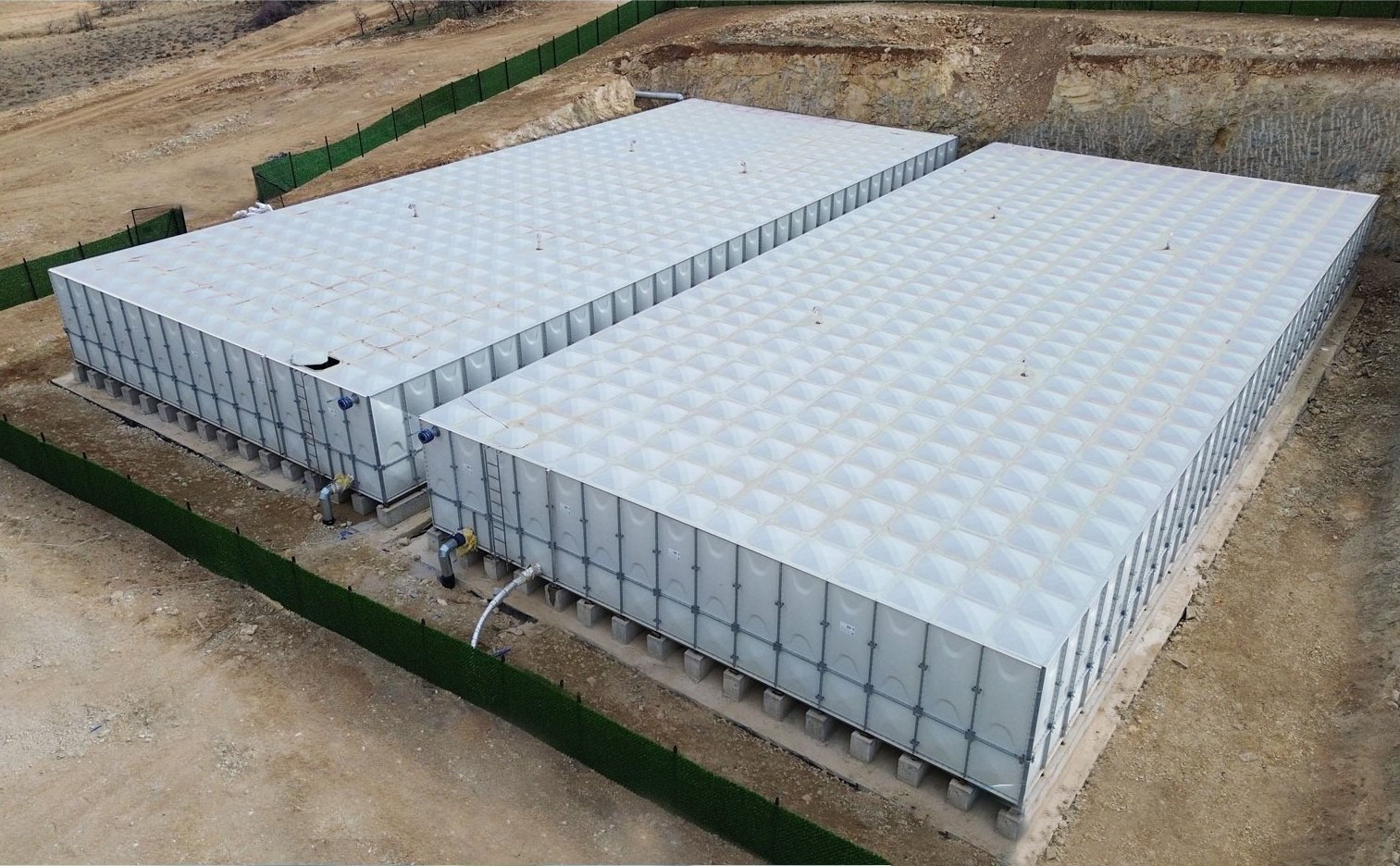
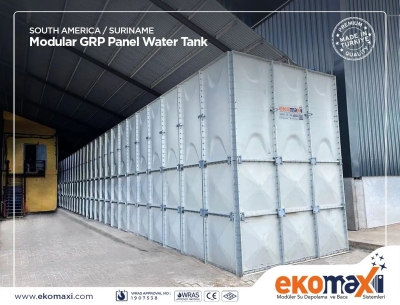
A GRP (glass-reinforced plastic) water tank is assembled on site by bolting together panels made from SMC compound that is hot-pressed in moulds under high pressure. Ekomaxi GRP tanks are configured from 1 x 1 m, 1 x 0.5 m and 0.5 x 0.5 m panels, at heights of 0.5 m, 1 m, 1.5 m and 2 m.
1. Hygiene and Water Quality
The most critical issue in any water tank is preserving the quality of the stored water. Concrete is porous by nature; hairline cracks and surface pores that develop over time can encourage sediment and biofilm. For this reason, the inner surface of a concrete drinking-water tank has to be lined with suitable waterproofing and coating materials, and that lining must be inspected regularly.
The inner surface of GRP panels is smooth and non-porous, and because the material does not let light through, algae cannot grow inside the tank. Ekomaxi GRP panels are WRAS approved for drinking water up to 50 °C (No. 241055054), are manufactured to EN 13280:2001, and their compliance with food regulations has been reported through WRAS and TSE tests. The smooth surface also makes periodic cleaning easier; see our water tank cleaning guide for a step-by-step procedure.
2. Installation Time and Site Workload
A concrete tank involves successive stages: excavation, formwork, reinforcement, pouring, curing and then waterproofing. The waiting time for the concrete to gain strength and the dependence on weather are the main factors that extend the schedule.
With a GRP tank, the panels are produced ready in the factory and shipped to site. The on-site work consists of bolting the panels together on a level, solid base and sealing the joints with sealing tape. Depending on the size of the tank, installation is usually completed within 1–3 days. As there is no wet work, the site stays clean and other trades are not held up.
3. Durability and Maintenance
In concrete tanks, ground settlement, temperature changes and seismic movement can cause cracks and leaks over time. Repairs usually require draining the tank completely, preparing the surface and re-coating it, which means an interruption to the water supply.
GRP does not corrode or rust and needs no painting or maintenance; Ekomaxi GRP water tanks have a minimum economic life of 50 years. The low weight of the material reduces the load on the building and its structural system, a significant advantage for rooftop and mezzanine installations. The modular design also allows intervention at panel level when needed.
4. Flexibility: Capacity, Location and Future Needs
Once poured, a concrete tank cannot be moved or enlarged. A GRP tank can be sized in half-metre steps, making it possible to achieve the maximum volume in restricted spaces such as basements, plant rooms and roofs. Thanks to its bolted construction, it can be dismantled and re-erected elsewhere if required. A partition can be added inside the tank to create a two-compartment design for different needs such as drinking water and fire water, which also avoids a complete shutdown during maintenance.
5. Climate and Insulation
In hot climates such as Iraq, the UAE and Saudi Arabia, or in the harsh winters of Eastern Europe and Central Asia, the temperature of the stored water is an important issue. Ekomaxi GRP panels can be produced with insulation by coating their outer surface with CFC- and HCFC-free polyurethane foam. Because the panels block UV light from entering the tank and can be installed outdoors, GRP stands out for projects in these regions. Ekomaxi's 3,000 m³ project in Sulaymaniyah (Iraq) and its 1,880 m³ project at The Boulevard, Erbil, are examples of the system in use under such conditions.
6. Total Cost of Ownership
Looking only at the initial investment can be misleading. A sound comparison should consider structural works and formwork labour, inner-surface coating, site costs incurred during installation, periodic maintenance and repair, and the service life of the tank. GRP water tank prices are calculated for each project according to capacity, panel height, insulation, base type, accessories and transport distance; for details, see our GRP water tank price guide.
Which One, and When?
- GRP water tank: drinking and domestic water, fire water and process water; rooftop, basement and plant-room installations; projects that must be commissioned quickly; facilities where capacity changes or relocation may be needed in future; export projects and remote sites.
- Reinforced concrete tank: special cases where the tank is designed as part of the building's structural system and it is certain that its location, capacity and operating conditions will not change in the long term.
GRP is also chosen for large municipal projects: the 2,970-tonne tank for KASKİ in Afşin and the 3 x 1,518-tonne installation in Elbistan are examples from Türkiye.
Conclusion
When hygiene, fast installation, low maintenance and flexibility are considered together, the modular GRP water tank offers a strong alternative to concrete tanks for many projects today. Ekomaxi, which has manufactured GRP water tanks domestically in Türkiye since 2018, works with its engineering team to determine the right capacity and dimensions for your project. To share your dimensions and intended use, contact us, or visit our GRP water tank page for product details.